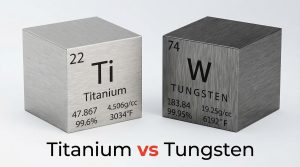
Titanium and tungsten are both considered high-performance metals, but they serve very different roles in engineering and manufacturing.
When comparing titanium vs. tungsten, engineers and buyers focus on key factors such as strength, weight, heat resistance, machinability, and cost.
Tungsten is extremely dense and performs well in high-temperature environments, while titanium is known for its high strength-to-weight ratio and excellent corrosion resistance.These differences make each material suitable for a wide range of applications, from jewelry such as rings to demanding industrial environments.
This article breaks down the key differences in properties, applications, and machining to help you choose the right material for your project.
What is Titanium?
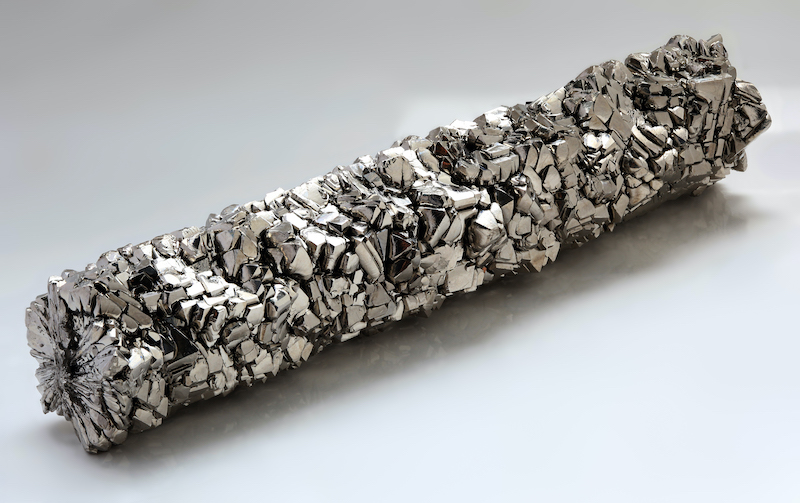
Titanium (Ti) is a transition metal with a silver-gray appearance. It was first identified in 1791 by William Gregor and was briefly referred to as “Gregorite,” although that name is rarely used today.
In nature, titanium is not found as a pure metal. It mainly exists in mineral ores such as ilmenite and rutile. To make it usable, these ores are processed through the Kroll process, where titanium tetrachloride (TiCl₄) is reduced with magnesium to produce titanium sponge. This sponge is then melted into ingots and further refined into forms suitable for industrial use.
Titanium is known for its high strength-to-weight ratio and excellent corrosion resistance. With a density of about 4.5 g/cm³, it is much lighter than steel while still offering strong mechanical performance, especially in alloy form. At the same time, it naturally forms a thin oxide layer on its surface, which protects it from corrosion in environments such as seawater, chemicals, and even the human body.
In engineering, titanium is typically supplied as:
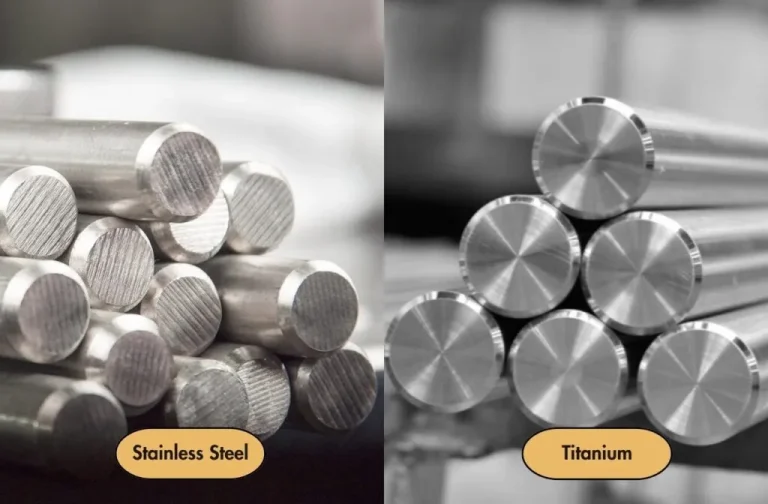
Bars, plates, and billets for CNC machining
Forged components for structural use
Powder for additive manufacturing processes such as DMLS
Although many grades exist, two are used most often in practice:
Grade 2 (Commercially Pure Titanium)
Grade 2 is widely used for its excellent corrosion resistance and good formability. It is commonly found in chemical equipment, marine environments, and general-purpose industrial components.
Grade 5 (Ti-6Al-4V)
Grade 5 is the most widely used titanium alloy and is often treated as the standard engineering-grade titanium. By adding aluminum and vanadium, it achieves much higher strength while keeping titanium’s low weight. It is widely used in aerospace, medical, and high-performance mechanical applications.
What Is Tungsten?
While both titanium and tungsten can be alloyed with other elements, titanium is typically used as different grades of the same metal. Tungsten, by contrast, is used in several distinct forms, including metal alloys and tungsten carbide, which behave very differently in engineering applications.
In practice, tungsten commonly refers to three material systems:
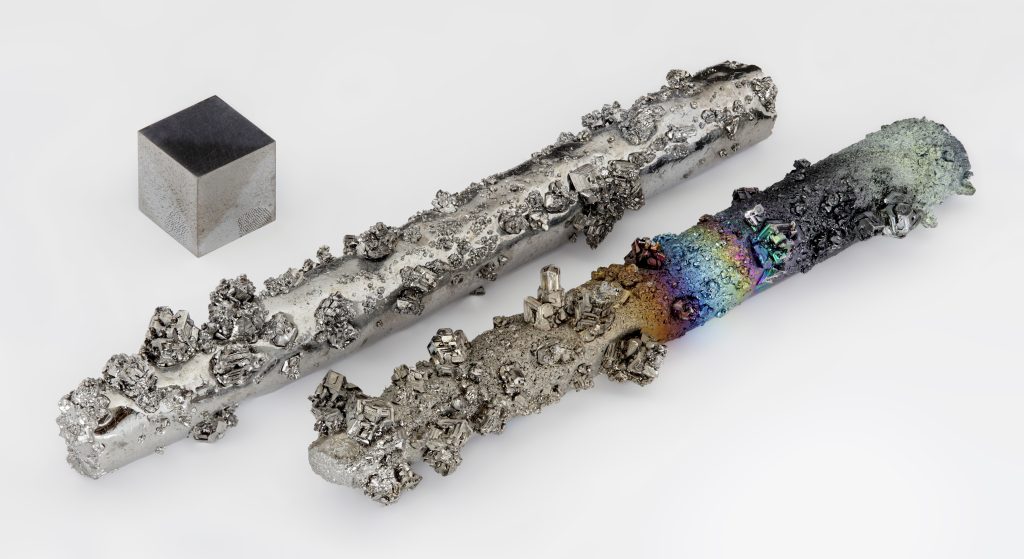
Pure tungsten (W)
Known for its extremely high melting point and stiffness, pure tungsten is used in high-temperature and electrical applications. However, it is relatively brittle at room temperature and can be difficult to process.
Tungsten heavy alloys (WHA)
These alloys typically contain 90–97% tungsten combined with elements such as nickel, iron, or copper. They retain tungsten’s high density while offering improved toughness and machinability, making them suitable for components such as counterweights, radiation shielding, and aerospace parts.
Cemented tungsten carbide (WC-Co)
A composite material made of tungsten carbide particles bonded with cobalt. It is extremely hard and wear-resistant, and is widely used in cutting tools, molds, and wear parts. Due to its hardness, it is usually processed by grinding or EDM rather than conventional machining.
In practice, when engineers refer to “machining tungsten,” they are often referring to tungsten heavy alloys, while “carbide” typically refers to WC-Co used in tooling.
Engineering Property Comparison
The comparison below focuses on commonly used engineering materials rather than abstract categories. In practice, materials such as Grade 2 titanium, Ti-6Al-4V, tungsten metal (W), tungsten heavy alloys, and tungsten carbide provide a more realistic basis for comparison.
Property
CP Ti (G2)
Ti-6Al-4V (G5)
Tungsten (W)
WHA
WC-Co
Density (g/cm³)
4.51
4.47
19.3
~17.0–18.8
~14.5
Tensile Strength (UTS)
345–483 MPa
~900 MPa (higher with heat treatment)
Limited use at RT due to brittleness
1000–1800 MPa
Not typically defined (use TRS/compression)
Yield Strength (0.2%)
276–352 MPa
~828 MPa (typical minimum)
Limited; compression more relevant
700–1510 MPa
Not typically specified
Hardness
~160 HV
~36 HRC
300–650 HV (condition-dependent)
~200–400 HV (grade-dependent)
82–94 HRA
Elastic Modulus (GPa)
~103
~105–116
~407
~330–385
up to ~650
Thermal Conductivity
Low (~20 W/m·K)
Low
High (~130–170 W/m·K)
Varies by composition
Moderate (~⅓ of copper)
Melting Point
~1668°C
~1538–1649°C
~3422°C
Very high
Very high
Corrosion Resistance
Very good
Very good
Environment-dependent
Good to excellent
Good (binder may be affected)
Biocompatibility
Good (used in medical)
Excellent (ELI grades)
Limited
Used in some medical shielding
Not typical for implants
Wear Resistance
Moderate (often needs coating)
Moderate (watch galling)
Better than Ti in some cases
Good
Excellent
Machinability and Manufacturing Considerations
In practice, choosing between titanium and tungsten is not just about material properties. It also depends on how practical the material is to machine. Both are difficult to process, but for very different reasons.
Machining Titanium
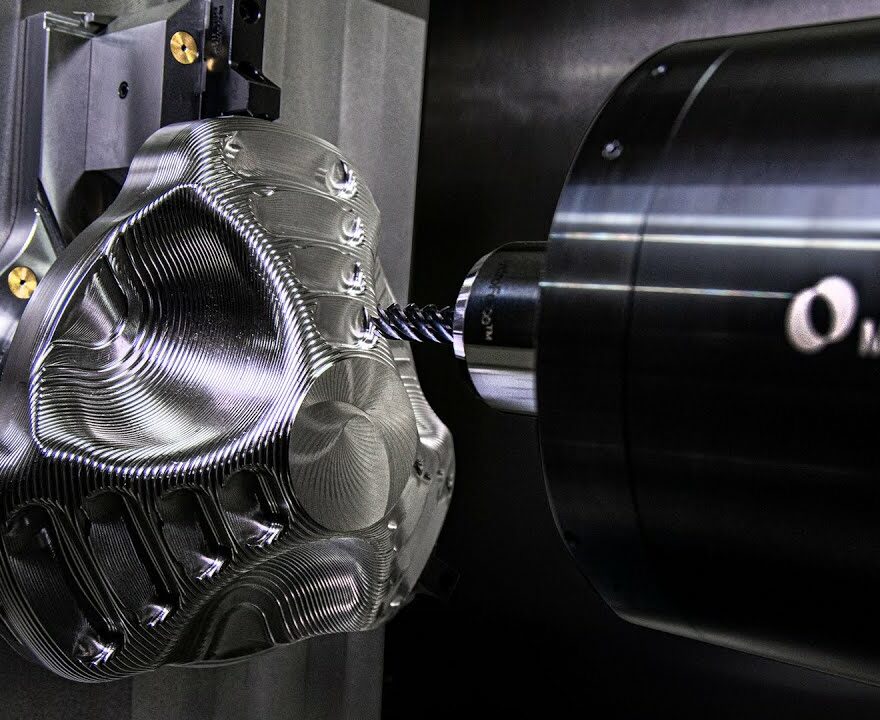
Titanium alloys are widely machined using conventional CNC processes, but they require tight process control. The main challenge is not just strength, but how titanium behaves during cutting. Because titanium has low thermal conductivity, heat tends to concentrate at the cutting edge, which accelerates tool wear.
Titanium is also chemically reactive at elevated temperatures, which can lead to built-up edge under poor cutting conditions. In addition, its relatively low elastic modulus increases the risk of deflection and chatter, particularly in thin-wall parts.
As a result, titanium machining usually requires:
Lower cutting speeds than steel
Sharp, wear-resistant carbide tools
Consistent coolant application to control temperature
Stable setups to reduce vibration
In practice, titanium machining operates within a relatively narrow process window. Cutting too conservatively can lead to rubbing and work hardening, while aggressive parameters can quickly raise cutting temperature and tool wear.
Despite these challenges, titanium remains a practical material for precision machining, especially for complex geometries and high-performance components.
Machining Tungsten and Tungsten Alloys
Tungsten heavy alloys (WHA) can be machined using conventional methods, but they are generally more difficult to cut than titanium. Their high density and stiffness produce higher cutting forces, and tool wear can become significant if parameters are not well controlled. Sharp cutting edges and conditions that avoid rubbing are especially important.
Typical considerations include:
Rigid machine setups to handle higher cutting forces
Moderate cutting speeds and controlled feed rates
Durable tooling materials to resist wear
Pure tungsten can also be machined in some cases, but it is more brittle at room temperature. That brittleness increases the risk of cracking or edge chipping during machining, which limits its use in complex machined parts.
Machining Tungsten Carbide
Tungsten carbide behaves very differently from both titanium and tungsten alloys. It is an extremely hard composite material, so conventional cutting methods are generally not suitable.
Instead, tungsten carbide components are usually finished by:
Grinding for precision shaping and surface finishing
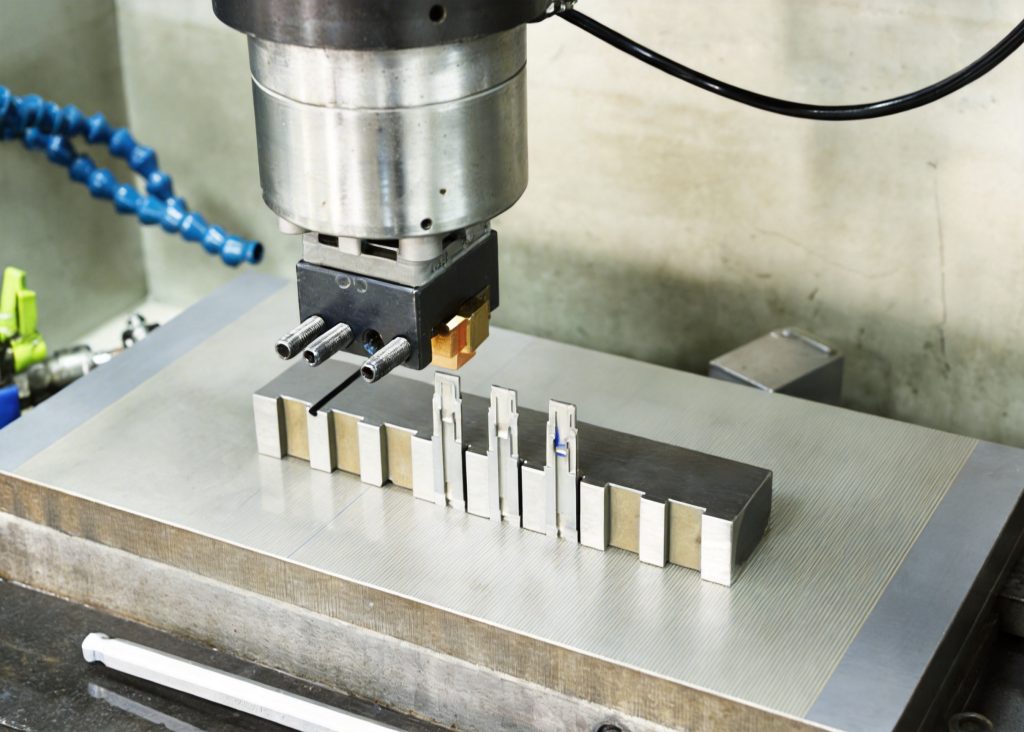
Electrical discharge machining (EDM) for more complex geometries
Because tungsten carbide is produced through powder metallurgy and sintering, it reaches its full hardness before final shaping. For this reason, it is typically used for tools and wear parts rather than components that require extensive conventional machining.
Fabrication, Forming, and Joining
Titanium: Easier to Weld Than to Form
Titanium can be formed and welded, but the difficulty depends on the grade. Ti-6Al-4V is generally difficult to form at room temperature, so more demanding forming is often done warm or hot to reduce springback and avoid damaging material properties. Grade 2 titanium, by contrast, is more ductile and easier to form, which is one reason it is widely used in chemical, marine, and medical equipment.
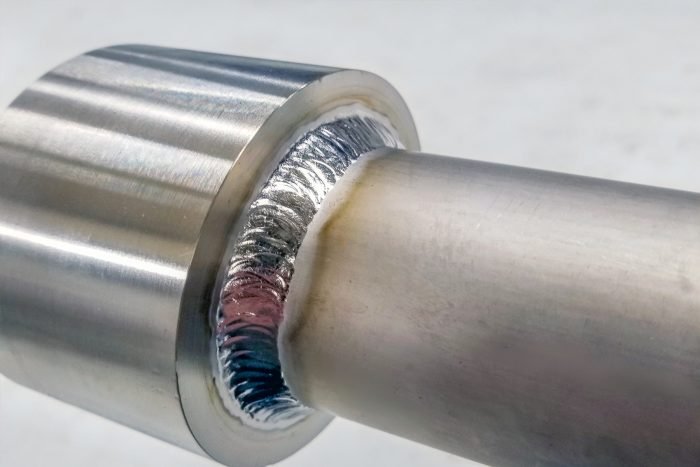
Titanium is also highly weldable, but shielding is critical. At high temperatures, it can absorb oxygen, nitrogen, and hydrogen, which reduces ductility and weakens weld quality. That is why processes such as GTAW, electron beam welding, and laser welding rely on strict inert-gas shielding, often with trailing shields to protect the hot weld zone.
Tungsten Materials: Usually Made by Powder Metallurgy
Tungsten-based materials follow a very different route. Tungsten heavy alloys and tungsten-copper materials are often made through powder metallurgy, then pressed, sintered, heat treated, and machined to final size. In W-Cu materials, copper may be infiltrated into a porous tungsten structure to combine tungsten’s heat resistance with copper’s conductivity.
For WC-Co cemented carbide, the process is even more distinct. Parts are typically formed near net shape and then sintered, but shrinkage during sintering can be significant, and as-sintered tolerances are usually relatively loose. When tighter tolerances are needed, final sizing is usually done by diamond grinding or EDM rather than conventional machining.
Joining methods are also different. Tungsten carbide components are more commonly assembled by brazing, shrink fitting, or mechanical retention than by welding.
Cost and Availability
Tungsten generally carries greater supply-chain risk than titanium. Because U.S. supply depends heavily on imports, its price and availability are more sensitive to trade restrictions and market disruptions. For engineering teams, that means sourcing often needs to be addressed earlier, especially for powders and specialized product forms.
Titanium is also influenced by global supply conditions, including sponge capacity and aerospace demand. Even so, its supply base is usually less concentrated than tungsten across many product categories. In practical terms, titanium often offers a more predictable sourcing path, even though it remains a premium material.
Both materials are expensive compared with common metals such as aluminum and carbon steel. In most cases, titanium is chosen when low weight and corrosion resistance matter most, while tungsten is reserved for applications that truly require extreme density, wear resistance, or high-temperature performance.
Environmental and Safety Considerations
Titanium chips and dust should be treated as a combustible hazard, especially in fine particulate form. In practice, that means controlling dust buildup, avoiding ignition sources, and using proper dust collection rather than treating titanium swarf like ordinary steel chips.
Tungsten carbide dust raises a different kind of risk. The main concern is worker exposure during grinding, polishing, or rework rather than flammability. In these operations, ventilation, dust capture, PPE, and good housekeeping are essential parts of the process.
Both titanium and tungsten can benefit from recycling, but in practice, recovery is not automatic.Tungsten recycling is already an established part of industrial supply, while titanium’s primary production is energy-intensive, which makes scrap recovery important from both a cost and environmental perspective.
Typical Industry Applications
Aerospace and High-Performance Structures
In aerospace and other weight-sensitive systems, titanium is often the better choice. Ti-6Al-4V is widely used in compressor components, airframe structures, spacecraft structures, pressure vessels, and fasteners. In these applications, its high strength-to-weight ratio and corrosion resistance justify the added cost and machining difficulty.
A good example is a thin-walled structural bracket. In this type of part, stiffness only needs to be good enough, while weight reduction is a primary requirement. In that situation, titanium’s low density becomes the deciding factor.
Radiation Shielding and Counterweights
When the goal is to place as much mass as possible into a limited volume, tungsten-based materials become much more attractive. In heavy-alloy form, tungsten offers the key advantage of very high density, which makes it especially useful for shielding and compact counterweights.
A typical example is a compact counterweight in an aerospace or industrial system. If the available space is fixed and the part must deliver a specific mass, titanium is often too light, even if its mechanical properties are otherwise suitable. In that case, a tungsten heavy alloy is the more practical solution.
Cutting Tools, Wear Parts, and Dies
For cutting tools, dies, and severe wear applications, cemented tungsten carbide (WC-Co) is usually the preferred material. A large share of tungsten use goes into cemented carbide parts for cutting and wear-resistant applications.
This is easy to understand from a materials standpoint. WC-Co is designed for extreme hardness, high stiffness, and strong abrasion resistance, which is why it performs so well in inserts, dies, and wear parts. The trade-off is brittleness, along with the fact that final shaping usually relies on grinding or EDM rather than conventional machining.
Titanium vs. Tungsten: How to Choose
Choosing between titanium and tungsten usually comes down to trade-offs. Weight, wear resistance, heat performance, corrosion resistance, machinability, and supply risk do not all point to the same answer.
A few practical rules help. If low weight is the priority, titanium is usually the better place to start. If you need as much mass as possible in a limited space, tungsten heavy alloy is often the better fit. If wear resistance is the main requirement, tungsten carbide is usually the reference material, although that often means designing around grinding or EDM rather than conventional machining. For implantable medical applications, titanium is usually the more common choice, while tungsten is more often used for shielding or specialized device components.
Decision Matrix for Engineers
Scoring: 5 = best fit, 1 = poor fit. Use this as a quick decision guide rather than a fixed specification.
Criterion
CP Ti Grade 2
Ti-6Al-4V Grade 5
Tungsten Heavy Alloy
Tungsten Carbide (WC-Co)
Weight-sensitive design
5
5
1
2
Extreme density in small volume
1
1
5
4
Conventional CNC turning/milling
3
3
4
1
Wear / abrasion dominated
2
2
4
5
Corrosion in many industrial media
4
4
3
3
High-temperature structural stability
3
3
5
4
Supply-chain / price stability
3
3
2
2
Conclusion
At Chiggo, we combine material knowledge with precision manufacturing to help customers build reliable parts for demanding applications. From DFM support to CNC machining and finishing, we work with titanium and tungsten-based materials based on real project needs.
If you are planning a titanium or tungsten part, reach out to Chiggo for engineering support and a custom manufacturing solution.